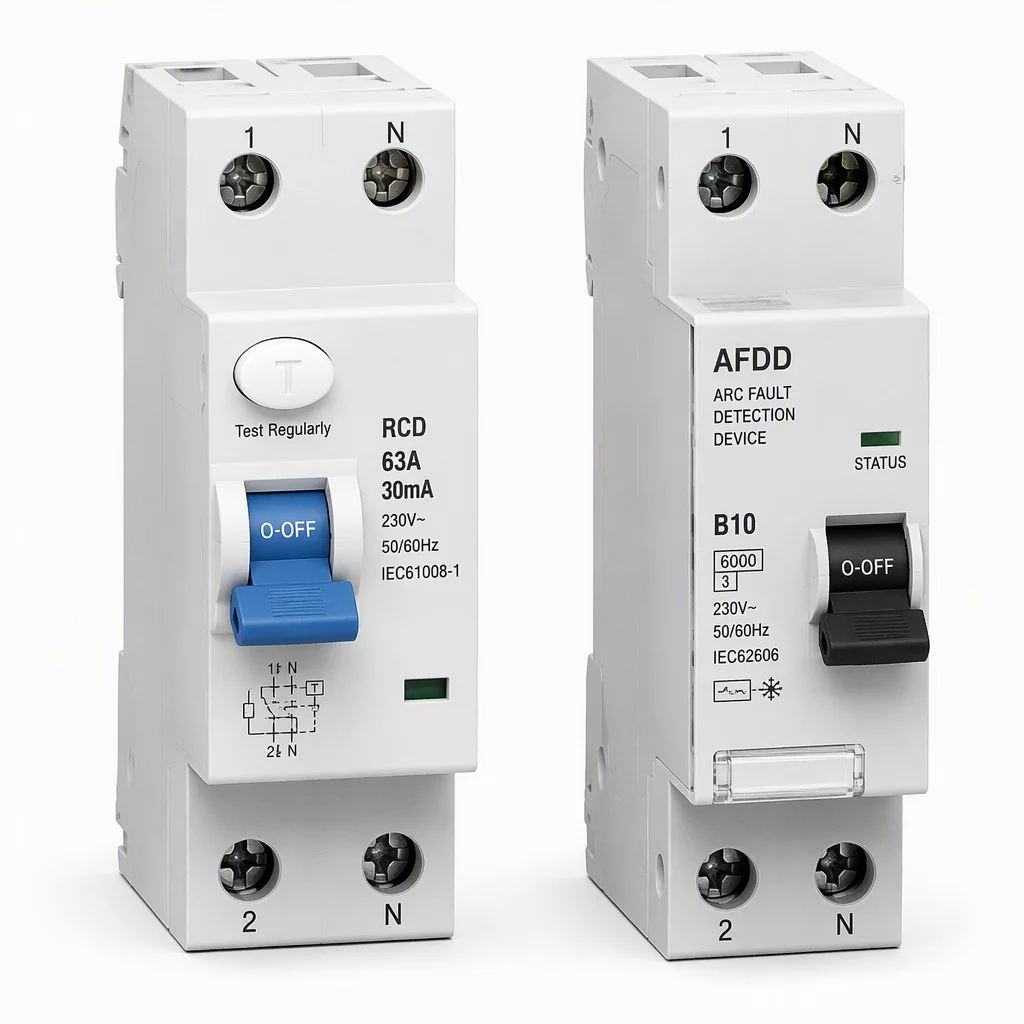
Electrical safety in modern homes relies on multiple layers of specialized circuit protection. While traditional miniature circuit breakers (MCBs) prevent standard overcurrent and direct short circuits, advanced hazards require dedicated sensing technologies. Two of the most critical protective components in contemporary distribution boards are Residual Current Devices (RCDs) and Arc Fault Detection Devices (AFDDs). Although both fit inside the consumer unit, their detection principles, target faults, and life-safety objectives differ substantially.
The Fundamental Mechanics of Residual Current Devices (RCDs)
An RCD monitors the balance of electrical current traveling between the live and neutral conductors. Under normal operating conditions, the inbound current along the live conductor precisely matches the returning current on the neutral line. When an imbalance occurs—for instance, when damaged insulation causes current to leak into the earth wire or through a person contacting an exposed conductor—the internal core transformer detects this leakage within milliseconds. By disconnecting power at leakage thresholds as low as 30mA, RCDs prevent fatal electric shocks and mitigate high-impedance earth fault risks.
RCDs protect human lives from lethal shock currents leaking to earth, whereas AFDDs actively analyze micro-arcing patterns to stop electrical fires before ignition occurs.
Why Arc Fault Detection Devices (AFDDs) Complete the Safety Chain
While an RCD is exceptionally effective at catching earth leakages, it remains completely blind to series arc faults occurring along a single severed conductor or loose screw terminal. This is where AFDDs become indispensable. Arc faults generate high-frequency micro-sparks with erratic current signatures that do not cause current leakage to earth or exceed standard breaker amperage limits. An AFDD houses an intelligent digital signal microprocessor that continuously analyzes the electrical waveform in real time, distinguishing between benign operational arcs from appliance motors and dangerous loose-connection sparking.
- RCD Primary Function: Detects current imbalance (typically 30mA threshold) to earth, preventing severe electrical shock and ground faults.
- AFDD Primary Function: Identifies dangerous high-frequency arcing across damaged conductors, loose terminals, or crushed cords to stop electrical fires.
- Combined Protection: Modern consumer units often integrate RCBOs with AFDD modules, providing complete overcurrent, shock, and thermal arc suppression in a single DIN-rail footprint.
Under the latest BS 7671 18th Edition Amendment regulations, installing AFDDs is strongly recommended or mandated across high-risk residential settings, including student accommodation, care homes, and sleeping accommodations. When paired with Type A bidirectional RCDs or RCBOs, modern consumer units deliver airtight protection against both lethal personal contact and concealed structural fire hazards.
Discussion & Reviews
0 ContributionsNo comments yet. Be the first to leave a comment!
Leave a Comment
Share your experience or ask a question regarding circuit specifications.