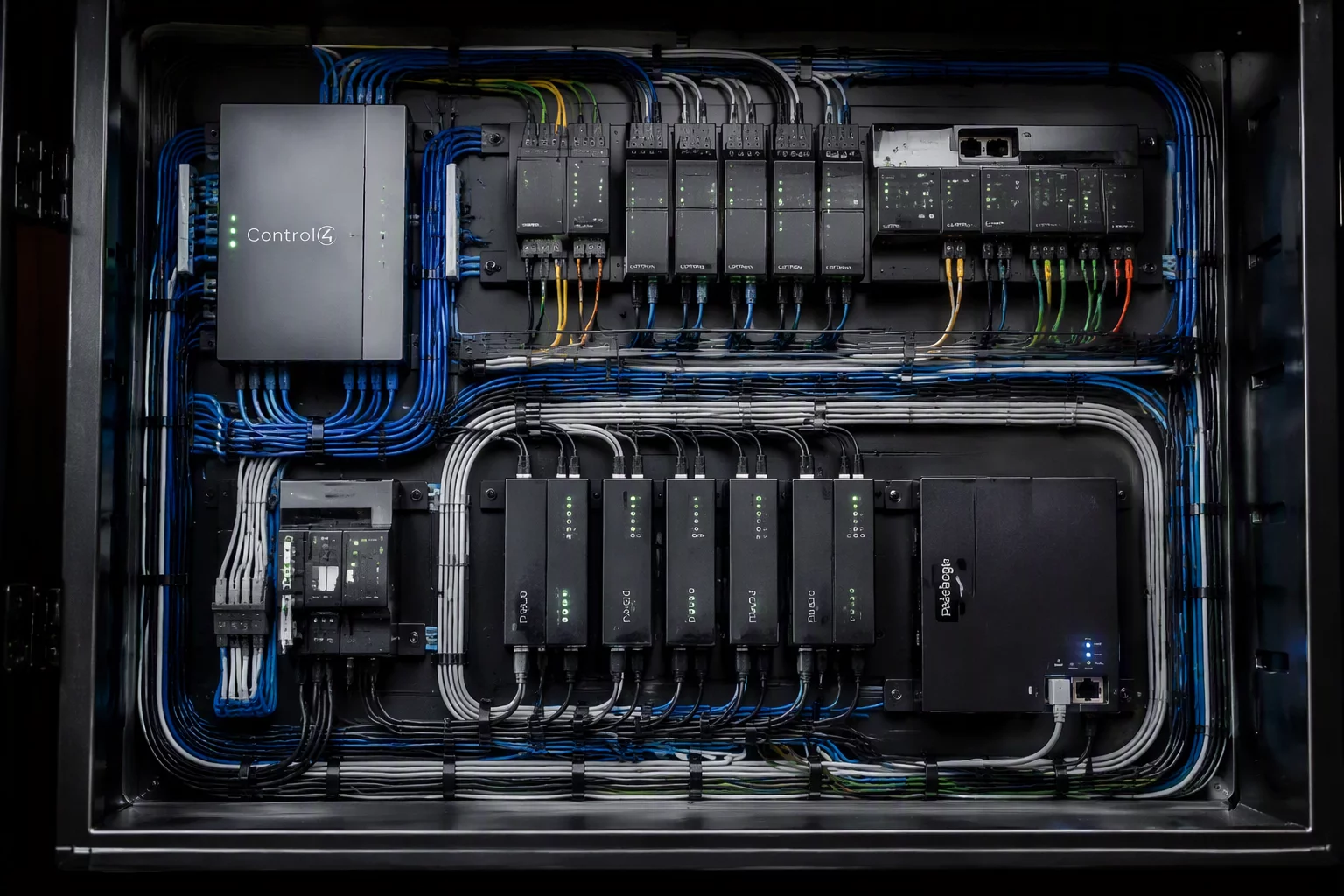
Automated lighting, motorized shading, intelligent climate controls, and integrated security hardware require far more than off-the-shelf wireless modules plugged into conventional sockets. A dependable residential automation network relies on physical copper infrastructure built from the distribution board outward. Retrofitting deep back-boxes, continuous neutral lines, and shielded data conduits eliminates signal dropouts, latency bottlenecks, and harmonic interference across the electrical installation.
Centralized Automation Enclosures and Neutral Integrity
Conventional switch drops in older buildings frequently omit the continuous neutral conductor at the wall plate, depending instead on switched-live loops. Contemporary smart dimmers, micro-modules, and touch panels demand dedicated neutral paths to keep internal microprocessors and radio transceivers continuously energized without flickering LED light loads. By rewiring terminal feeds and organizing multi-channel smart relays inside dedicated secondary enclosures, homeowners gain centralized diagnostic access, improved thermal dissipation, and seamless fail-safe circuit protection.
Reliable smart homes start at the distribution board. Without clean power delivery, dedicated neutral lines, and shielded low-voltage segregation, intelligent hardware cannot operate with mission-critical stability.
Physical Infrastructure and Interference Mitigation
High-voltage alternating current generates electromagnetic fields that distort sensitive automation signals. Our engineering process incorporates strict spatial segregation between 230V mains cabling and low-voltage structured lines. From home cinema AV racks to smart motorized valve actuators, every pathway receives proper shielding, surge containment, and individual circuit protection.
- Continuous dedicated neutral conductors pulled to every light switch, sensor point, and junction location
- Conduit separation ensuring minimum 50mm clearance between Cat6A/KNX bus lines and 230V supply cables
- Integrated Type 2 Surge Protective Devices (SPDs) safeguarding sensitive microcontrollers against transient spikes
Each installation finishes with rigorous continuity verification, insulation resistance testing at 500V DC, and protocol-level continuity checks. Full documentation packages provide complete circuit labeling and technical schematics, ensuring effortless future expansions, firmware upgrades, and maintenance.
Discussion & Inquiries
0 Verified ContributionsNo comments yet. Be the first to leave a comment or inquire about your smart home wiring project.
Leave a Comment
Share your experience or ask a question regarding circuit specifications.